---
title: What Does a Damp Survey Involve? | Full Guide
description: Wondering what does a damp survey involve? Understand the full process, from initial inspection to moisture readings and final report.
image: https://www.jag-ps.co.uk/hubfs/what-does-a-damp-survey-involve.png
---
[](https://www.jag-ps.co.uk/)
[](https://www.jag-ps.co.uk/)
- About
- [About us](https://www.jag-ps.co.uk/independant-damp-surveyor)
- [Meet the team](https://www.jag-ps.co.uk/meet-the-team)
- Services
- [Damp & Mould Surveys](https://www.jag-ps.co.uk/damp-and-mould-surveys)
- [Air Quality & Surface Testing (PRV)](https://www.jag-ps.co.uk/commercial-air-quality-testing)
- [Water Restoration](https://www.jag-ps.co.uk/water-damage-restoration-service)
- [Commercial Leak Detection](https://www.jag-ps.co.uk/commercial-water-leak-detection-services)
- [Legal Disrepair Surveys](https://www.jag-ps.co.uk/damp-disrepair-specialist)
- Sectors
- [Social Housing](https://www.jag-ps.co.uk/damp-survey-for-housing-development)
- [Private Landlords & Letting Agents](https://www.jag-ps.co.uk/damp-survey-for-landlords)
- [Facilities Management](https://www.jag-ps.co.uk/commercial-proprty-damp-survey)
- [High Net Worth Individuals](https://www.jag-ps.co.uk/high-value-properties)
- Resources
- [News](https://www.jag-ps.co.uk/news)
- [Accreditations / Partners Page](https://www.jag-ps.co.uk/accreditations-and-trusted-partners)
- [Contact](https://www.jag-ps.co.uk/contact-us)
More results
[](https://www.jag-ps.co.uk/hs/cta/wi/redirect?encryptedPayload=AVxigLJFUX8fpKxXmORYUm4989vKoUbprOaHd3VvOKmksMB0r7yYY8V1eP9MJ%2Bk%2BnIUw%2FN5W1aE0wAWmB1cwk3WXA31F9hc13rDV3mrINZxWPtd5hwhquRYB7UZDjBTWNVAGIDuKcKpxdarzBiEzlXxhXie0qOZJU%2BZfemI4j4NULFxIWMeGlFPlJIUIbPzQ&webInteractiveContentId=401945745608&portalId=147351228)
[](https://www.jag-ps.co.uk/hs/cta/wi/redirect?encryptedPayload=AVxigLJFUX8fpKxXmORYUm4989vKoUbprOaHd3VvOKmksMB0r7yYY8V1eP9MJ%2Bk%2BnIUw%2FN5W1aE0wAWmB1cwk3WXA31F9hc13rDV3mrINZxWPtd5hwhquRYB7UZDjBTWNVAGIDuKcKpxdarzBiEzlXxhXie0qOZJU%2BZfemI4j4NULFxIWMeGlFPlJIUIbPzQ&webInteractiveContentId=401945745608&portalId=147351228)
[](https://www.jag-ps.co.uk/hs/cta/wi/redirect?encryptedPayload=AVxigLJFUX8fpKxXmORYUm4989vKoUbprOaHd3VvOKmksMB0r7yYY8V1eP9MJ%2Bk%2BnIUw%2FN5W1aE0wAWmB1cwk3WXA31F9hc13rDV3mrINZxWPtd5hwhquRYB7UZDjBTWNVAGIDuKcKpxdarzBiEzlXxhXie0qOZJU%2BZfemI4j4NULFxIWMeGlFPlJIUIbPzQ&webInteractiveContentId=401945745608&portalId=147351228)
- About
- [About us](https://www.jag-ps.co.uk/independant-damp-surveyor)
- [Meet the team](https://www.jag-ps.co.uk/meet-the-team)
- Services
- [Damp & Mould Surveys](https://www.jag-ps.co.uk/damp-and-mould-surveys)
- [Air Quality & Surface Testing (PRV)](https://www.jag-ps.co.uk/commercial-air-quality-testing)
- [Water Restoration](https://www.jag-ps.co.uk/water-damage-restoration-service)
- [Commercial Leak Detection](https://www.jag-ps.co.uk/commercial-water-leak-detection-services)
- [Legal Disrepair Surveys](https://www.jag-ps.co.uk/damp-disrepair-specialist)
- Sectors
- [Social Housing](https://www.jag-ps.co.uk/damp-survey-for-housing-development)
- [Private Landlords & Letting Agents](https://www.jag-ps.co.uk/damp-survey-for-landlords)
- [Facilities Management](https://www.jag-ps.co.uk/commercial-proprty-damp-survey)
- [High Net Worth Individuals](https://www.jag-ps.co.uk/high-value-properties)
- Resources
- [News](https://www.jag-ps.co.uk/news)
- [Accreditations / Partners Page](https://www.jag-ps.co.uk/accreditations-and-trusted-partners)
- [Contact](https://www.jag-ps.co.uk/contact-us)
[](https://www.jag-ps.co.uk/hs/cta/wi/redirect?encryptedPayload=AVxigLJFUX8fpKxXmORYUm4989vKoUbprOaHd3VvOKmksMB0r7yYY8V1eP9MJ%2Bk%2BnIUw%2FN5W1aE0wAWmB1cwk3WXA31F9hc13rDV3mrINZxWPtd5hwhquRYB7UZDjBTWNVAGIDuKcKpxdarzBiEzlXxhXie0qOZJU%2BZfemI4j4NULFxIWMeGlFPlJIUIbPzQ&webInteractiveContentId=401945745608&portalId=147351228)

J A Gilbert Property Services Limited
Index House
St George’s Lane
Ascot
SL5 7ET
All Topics
[All Topics](https://www.jag-ps.co.uk/news)[Damp & Mould surveys](https://www.jag-ps.co.uk/news/tag/damp-mould-surveys)[Air Quality & Surface Testing](https://www.jag-ps.co.uk/news/tag/air-quality-surface-testing)[Commercial](https://www.jag-ps.co.uk/news/tag/commercial)[Mould Removal](https://www.jag-ps.co.uk/news/tag/mould-removal)[Mould removal and remediation](https://www.jag-ps.co.uk/news/tag/mould-removal-and-remediation)[Housing Disrepair](https://www.jag-ps.co.uk/news/tag/housing-disrepair)[Water Damage Restoration](https://www.jag-ps.co.uk/news/tag/water-damage-restoration)
# What Does A Damp Survey Involve?
By [**JAG**](https://www.jag-ps.co.uk/news/author/jag) on Jun 30, 2026, 11:00:01 AM
Finding damp in any property can be a bit of a worry because you can’t always tell how serious the problem is. Is it just a small patch on a wall that is easily dealt with or is that musty smell and peeling paint signs of something more serious like rising damp and structural defects?
[](https://www.jag-ps.co.uk/hs/cta/wi/redirect?encryptedPayload=AVxigLJGvldVFbkLXwaRgIN4MUXqHiQ%2BC0VBbJA5NfFM76xFs9qiHyY4HbjPvkaj5m16WoNtqtj7XM1Dnqgf1DCY0V4nOvgMPk245UkZ14QtkfBoBJCNNrB9jTTibT%2Fdc77glWzSEJVpSangzusBwzwh1gAwSwAhxT9p2%2FOOmTSPYaBP984ebiS1yJEZN57BVDkHVCmhWNlbUA%3D%3D&webInteractiveContentId=316390601917&portalId=147351228)
Without a professional damp survey you can’t definitely confirm the extent of the damp, what’s causing it and the best way to treat it. Commissioning a damp survey, however, can give you the answers you need and ensure any remedial action stops it coming back.
## **What Is A Damp Survey?**
So, [what does a damp survey involve](https://www.jag-ps.co.uk/damp-and-mould-surveys), you might ask? Well, it’s a structured inspection carried out to identify the presence, source and severity of moisture problems within a building.
A common misconception is it’s merely a visual check but actually a professional survey is far more than that. A professional damp surveyor assesses:
- The type of damp present
- The extent of moisture within walls and floors
- The root cause
- Any related structural concerns
- The risk of further damage
The outcome is a detailed report explaining what’s happening and what treatment is required.
For landlords, having access to such documentation not only provides a clear course of action but it also satisfies compliance requirements too.
## **Why Damp Shouldn’t Be Ignored?**
Damp rarely resolves on its own and if you discover it in your properties, it’s more often than not a sign of other hidden problems. If you don’t take action it can cause mould growth, timber decay, structural damage and plaster deterioration. This inevitably leads to tenant complaints and health concerns which can escalate into legal cases if not dealt with swiftly.
This is particularly pertinent in housing providers where there is a duty of care to protect tenants and occupants. You have a responsibility under the Homes (Fitness for Human Habitation) Act 2018 and Section 11 of the Landlord and Tenant Act 1985 to provide a property that is safe, healthy and free from structural issues. Damp which is left untreated means you could be failing in that duty, taken to court and fined.
## **What Does A Damp Survey Involve In Practice?**
To fully understand what a damp survey involves it’s helpful to understand the stages.
- **Visual Inspection**
The survey begins with a thorough visual assessment of the affected areas, external walls, roofing and guttering, plumbing, ventilation systems, ground levels and drainage. A professional damp surveyor will look beyond visible staining to assess the wider building context.
- **Moisture Readings**
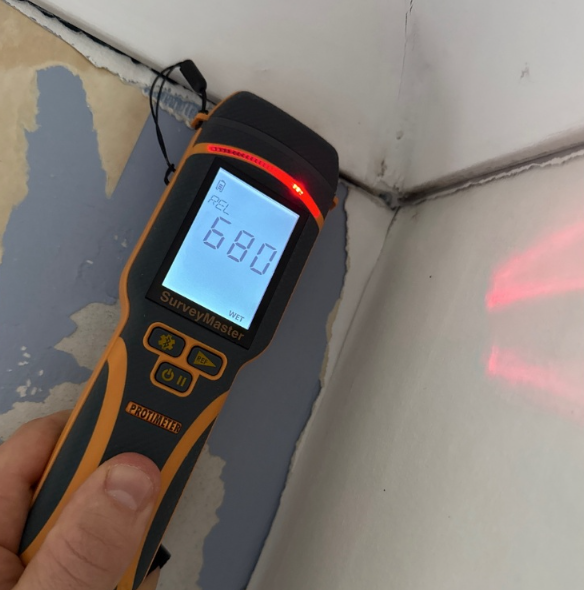
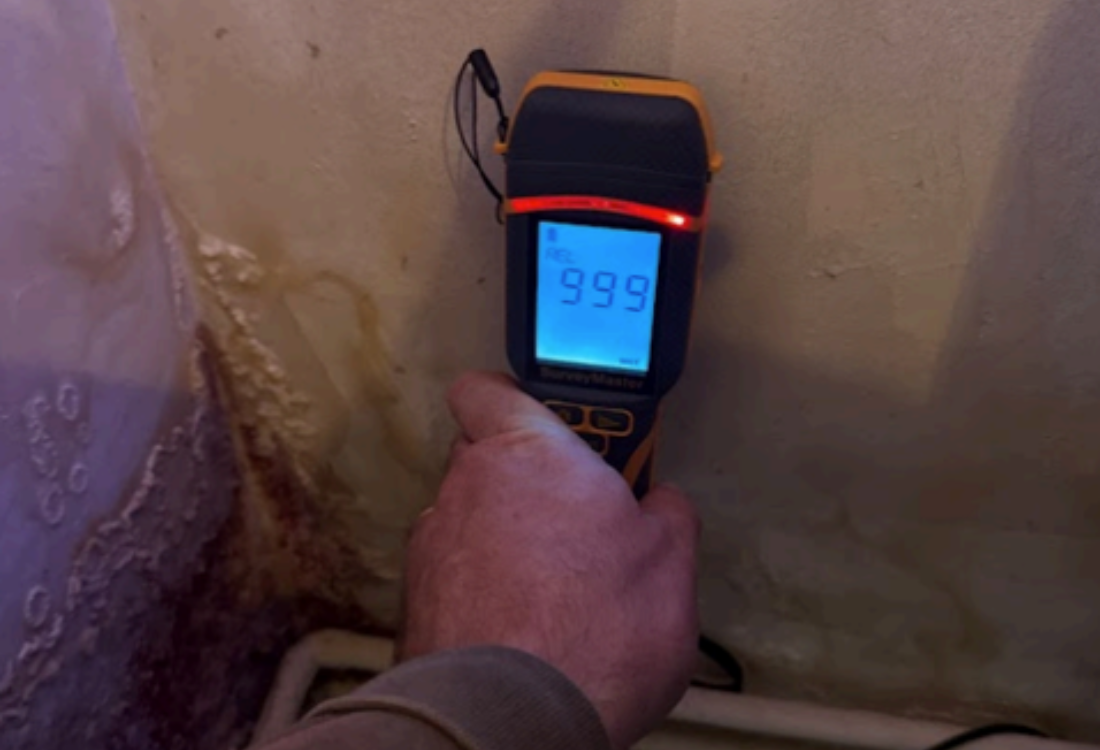
Specialist moisture meters are used to measure the level of moisture within walls, floors and timber. These readings help determine whether the damp is active, how far the moisture has travelled and the likely origin point. Patterns in readings often reveal whether the issue is rising damp, penetrating [damp or condensation](https://www.jag-ps.co.uk/news/damp-mould-condensation) related.
- **Identifying the Type of Damp**
Not all damp is the same. A proper survey distinguishes between rising damp where moisture is travelling up from the ground and penetrating damp where water is entering from external defects. It will also assess the likelihood of damp coming from condensation – where moisture forms internally due to ventilation or heating imbalances – and plumbing leaks from internal systems. When damp is investigated superficially misdiagnosis is common. But understanding the type of damp determines the best solution.
- **Ventilation Assessment**
Poor ventilation is a frequent contributor to condensation and mould. A damp survey may include assessment of extractor fan performance window ventilation, airflow pathways and occupancy patterns.
- **External Defect Review**
Water ingress can come from external defects or internal issues, such as a leaking waste pipe concealed in boxing. A professional damp surveyor will assess cracked render, damaged brickwork, blocked gutters, faulty roof tiles and inadequate drainage to see if it is the cause of the issue.
- **Reporting And Recommendations**
The final stage is a written report outlining the findings, the moisture readings, the likely cause, the risk assessment, the recommended remedial actions and the estimated urgency. If you’re a landlord or property manager this creates a defensible paper trail and demonstrates the issue has been investigated professionally and proportionately.
## **When Should You Commission A Damp Survey?**
You should consider a damp survey when:
- A tenant raises repeated damp or mould complaints
- You notice persistent staining, blistering paint or bubbling and cracking plaster
- There is visible mould growth
- A [property](https://www.jag-ps.co.uk/news/how-damp-and-mould-affect-property-value-what-homebuyers-need-to-know) is being purchased or re-let
- Insurers request condition evidence
- You suspect structural moisture problems
## **DIY vs Professional Assessment**
While basic moisture meters are available commercially, interpreting readings correctly requires experience. A professional damp surveyor will have knowledge of building construction and understand moisture behaviour. They’ll also be able to identify false positives and distinguish cosmetic damage from structural concern.
With the best will in the world, if you’re not expert in these areas it’s easy to get the diagnosis wrong which means you end up carrying out unnecessary works or not doing enough to eliminate the problem.
Damp problems are rarely just cosmetic but understanding [what a damp survey involves](https://www.jag-ps.co.uk/damp-and-mould-surveys) helps you approach issues methodically rather than reactively. A professional damp survey provides clarity, protects occupant wellbeing and reduces long-term repair costs. When managed early and properly, damp is far easier (and cheaper) to resolve.
**Concerned about damp in your property?** [**Book a professional damp survey**](https://www.jag-ps.co.uk/request-a-survey?hsCtaAttrib=316390601917) **today and receive clear, evidence-based recommendations you can act on with confidence.**
**[](https://www.jag-ps.co.uk/hs/cta/wi/redirect?encryptedPayload=AVxigLJnoteEe26Ix2mhJpyH7InhFwylaYT%2BCRrvDmCYlifswDpQtlxRu8JuTCiyvt8jtOj7eZtE0Mlv5mZUzL7Ah7Nsj3ijxUnj7kVRgYONSTdNy%2BfSU2Mg4Rx0qXE%2Fy2KvVt4uH6RkvkmxY50fAGF7LkW4bQbsc2s9KRxDu59vhbnqybEXyMPfsKVTaEFfBay9Cw%3D%3D&webInteractiveContentId=387072542918&portalId=147351228)**
- Recent
- Topics
- Archive
Recent
Topics
- [Damp & Mould surveys (26)](https://www.jag-ps.co.uk/news/tag/damp-mould-surveys)
- [Air Quality & Surface Testing (9)](https://www.jag-ps.co.uk/news/tag/air-quality-surface-testing)
- [Commercial (8)](https://www.jag-ps.co.uk/news/tag/commercial)
- [Mould Removal (6)](https://www.jag-ps.co.uk/news/tag/mould-removal)
- [Mould removal and remediation (3)](https://www.jag-ps.co.uk/news/tag/mould-removal-and-remediation)
- [Housing Disrepair (1)](https://www.jag-ps.co.uk/news/tag/housing-disrepair)
- [Water Damage Restoration (1)](https://www.jag-ps.co.uk/news/tag/water-damage-restoration)
See all
Archive
- [September 2026 (2)](https://www.jag-ps.co.uk/news/archive/2026/09)
- [August 2026 (4)](https://www.jag-ps.co.uk/news/archive/2026/08)
- [July 2026 (4)](https://www.jag-ps.co.uk/news/archive/2026/07)
- [June 2026 (3)](https://www.jag-ps.co.uk/news/archive/2026/06)
- [April 2026 (4)](https://www.jag-ps.co.uk/news/archive/2026/04)
- [January 2026 (1)](https://www.jag-ps.co.uk/news/archive/2026/01)
- [October 2025 (2)](https://www.jag-ps.co.uk/news/archive/2025/10)
- [September 2025 (4)](https://www.jag-ps.co.uk/news/archive/2025/09)
- [August 2025 (3)](https://www.jag-ps.co.uk/news/archive/2025/08)
- [July 2025 (3)](https://www.jag-ps.co.uk/news/archive/2025/07)
- [June 2025 (4)](https://www.jag-ps.co.uk/news/archive/2025/06)
- [May 2025 (1)](https://www.jag-ps.co.uk/news/archive/2025/05)
- [February 2025 (3)](https://www.jag-ps.co.uk/news/archive/2025/02)
- [January 2025 (2)](https://www.jag-ps.co.uk/news/archive/2025/01)
- [November 2024 (3)](https://www.jag-ps.co.uk/news/archive/2024/11)
- [September 2024 (1)](https://www.jag-ps.co.uk/news/archive/2024/09)
- [August 2024 (1)](https://www.jag-ps.co.uk/news/archive/2024/08)
- [December 2023 (1)](https://www.jag-ps.co.uk/news/archive/2023/12)
- [June 2023 (3)](https://www.jag-ps.co.uk/news/archive/2023/06)
See all
### Subscribe by email
Previous story
[← How To Test Indoor Air Quality In Commercial Office Buildings?](https://www.jag-ps.co.uk/news/indoor-air-quality-testing-office-buildings)
Next story
[How Social Housing Teams Should Handle Damp and Mould Reports? →](https://www.jag-ps.co.uk/news/damp-and-mould-survey-social-housing-guide)
## You May Also Like
These Related Stories
[Mould Surveys vs. DIY Kits: Why Professional Testing Matters?](https://www.jag-ps.co.uk/news/mould-survey-vs-diy-kits)
[Damp & Mould surveys](https://www.jag-ps.co.uk/news/tag/damp-mould-surveys)
### Mould Surveys vs. DIY Kits: Why Professional Testing Matters?
Apr 30, 2026, 10:00:00 AM
[Damp and Mould: A Guide for Housing Professionals](https://www.jag-ps.co.uk/news/guide)

[Damp & Mould surveys](https://www.jag-ps.co.uk/news/tag/damp-mould-surveys)
### Damp and Mould: A Guide for Housing Professionals
Feb 21, 2025, 3:30:00 PM
[DIY vs Professional Damp and Mould Surveys: What You Need to Know](https://www.jag-ps.co.uk/news/diy-vs-professional-damp-and-mould-surveys-what-you-need-to-know-jagdiy-vs-professional-damp-and-mould-surveys-what-you-need-to-know)

[Damp & Mould surveys](https://www.jag-ps.co.uk/news/tag/damp-mould-surveys)
### DIY vs Professional Damp and Mould Surveys: What You Need to Know
Jul 28, 2025, 3:00:00 PM
### No Comments Yet
Let us know what you think
#### [](https://www.jag-ps.co.uk/)
J A Gilbert Property Services Limited, Index House, St George’s Lane, Ascot, SL5 7ET
[01344578851](tel:01344578851)
VAT Number - GB420008069
Company Number - 14221295
Services
- [Damp & Mould Surveys](https://www.jag-ps.co.uk/damp-and-mould-surveys)
- [Air Quality & Surface Testing (PRV)](https://www.jag-ps.co.uk/commercial-air-quality-testing)
- [Water Restoration](https://www.jag-ps.co.uk/water-damage-restoration-service)
- [Commercial Leak Detection](https://www.jag-ps.co.uk/commercial-water-leak-detection-services)
- [Legal Disrepair Surveys](https://www.jag-ps.co.uk/damp-disrepair-specialist)
Sectors
- [Social Housing](https://www.jag-ps.co.uk/damp-survey-for-housing-development)
- [Private Landlords & Letting Agents](https://www.jag-ps.co.uk/damp-survey-for-landlords)
- [Facilities Management](https://www.jag-ps.co.uk/commercial-proprty-damp-survey)
- [High Net Worth Individuals](https://www.jag-ps.co.uk/high-value-properties)
Resources
- [About Us](https://www.jag-ps.co.uk/independant-damp-surveyor)
- [Our Team](https://www.jag-ps.co.uk/meet-the-team)
- [Accreditations](https://www.jag-ps.co.uk/accreditations-and-trusted-partners)
- [Our Team](https://www.jag-ps.co.uk/meet-the-team)
Legal
- [Terms](https://www.jag-ps.co.uk/terms-conditions)
- [Privacy](https://www.jag-ps.co.uk/privacy-policy)
- [Cookies](https://www.jag-ps.co.uk/cookie-policy)
Copyright © 2026 J A Gilbert Property Services Limited. Designed and developed by [JDR Group](http://www.jdrgroup.co.uk).
- [Terms](https://147351228.hs-sites-eu1.com/terms-conditions)
- [Privacy](https://147351228.hs-sites-eu1.com/privacy-policy)
- [Cookies](https://147351228.hs-sites-eu1.com/cookie-policy)
```json
{
"@context" : "https://schema.org",
"@type" : "BlogPosting",
"author" : {
"@type" : "Person",
"name" : "JAG",
"url" : "https://www.jag-ps.co.uk/news/author/jag"
},
"dateModified" : "2026-09-28T08:21:48.384Z",
"datePublished" : "2026-06-30T10:00:01.000Z",
"headline" : "What Does a Damp Survey Involve? | Full Guide",
"image" : [ "https://www.jag-ps.co.uk/hubfs/what-does-a-damp-survey-involve.png" ],
"mainEntityOfPage" : {
"@id" : "https://www.jag-ps.co.uk/news/what-does-a-damp-survey-involve",
"@type" : "WebPage"
},
"publisher" : {
"@type" : "Organization",
"logo" : {
"@type" : "ImageObject",
"url" : "https://www.jag-ps.co.uk/hubfs/Color+logo+-+no+background.webp"
}
}
}
```
```json
{
"@context" : "https://schema.org",
"@type" : "LocalBusiness",
"address" : {
"@type" : "PostalAddress",
"addressCountry" : "UK",
"addressLocality" : "Ascot",
"addressRegion" : "Berkshire",
"postalCode" : "SL5 7ET",
"streetAddress" : "210, INDEX HOUSE, St George's Ln"
},
"alternateName" : "J A Gilbert Property Services ",
"contactPoint" : {
"@type" : "ContactPoint",
"areaServed" : "GB",
"availableLanguage" : "en",
"contactType" : "customer service",
"telephone" : "+44134 459 6162"
},
"geo" : {
"@type" : "GeoCoordinates",
"latitude" : 51.4103,
"longitude" : -0.6745
},
"image" : "https://www.jag-ps.co.uk/hubfs/JAG%20Banner%20(1).svg",
"logo" : "https://www.jag-ps.co.uk/hs-fs/hubfs/Color+logo+-+no+background.webp",
"name" : "J A Gilbert Property Services Limited",
"openingHours" : [ "Mo-Fr 08:00-17:00", "Sa 09:00-14:00", "Su Closed" ],
"priceRange" : "£",
"sameAs" : [ "https://www.facebook.com/people/JAG-Property-Services/61558254444288/", "https://uk.linkedin.com/company/jag-ps" ],
"telephone" : "0134 495 1764",
"url" : "https://www.jag-ps.co.uk/"
}
```
```json
{
"@context" : "https://schema.org",
"@type" : "WebPage",
"description" : "Wondering what does a damp survey involve? Understand the full process, from initial inspection to moisture readings and final report.",
"inLanguage" : "en-GB",
"name" : "What Does a Damp Survey Involve? | Full Guide",
"publisher" : {
"@type" : "Organization",
"logo" : {
"@type" : "ImageObject",
"url" : "https://www.jag-ps.co.uk/hs-fs/hubfs/Color+logo+-+no+background.webp"
},
"name" : "J A Gilbert Property Services Limited",
"url" : "https://www.jag-ps.co.uk/"
},
"url" : "https://www.jag-ps.co.uk/news/what-does-a-damp-survey-involve"
}
```
```json
{
"@context" : "https://schema.org",
"@type" : "BreadcrumbList",
"itemListElement" : [ {
"@type" : "ListItem",
"item" : "https://www.jag-ps.co.uk/",
"name" : "Home",
"position" : 1
}, {
"@type" : "ListItem",
"item" : "https://www.jag-ps.co.uk/news/what-does-a-damp-survey-involve",
"name" : "What Does A Damp Survey Involve?",
"position" : 2
} ]
}
```